
Carl Van Vechten
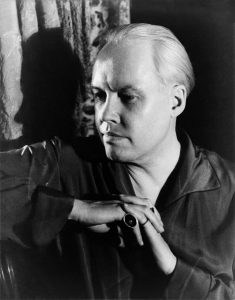
Carl Van Vechten was a writer, critic, and photographer who collaborated with some of the most influential figures of the New York avant-garde. He served as editor, publisher, and literary agent for artists such as Langston Hughes, Gertrude Stein, and Mina Loy in both official and unofficial capacities. A collector and admirer of African-American art, he was among the first to expose the works of Harlem Renaissance artists to a larger audience.
Van Vechten was born on June 17, 1880 in Cedar Rapids, Iowa. He showed an interest in the arts throughout his youth and studied music and visual art during his time at the University of Chicago. He began his journalistic career writing for the University of Chicago Weekly, then the Chicago American after graduating. He moved to New York City in 1906, where he worked as a music critic for the New York Times. He took a leave of absence in 1907 to travel Europe and study opera. While abroad, he married Anna Snyder, a longtime friend from his hometown.
Van Vechten’s travels in Europe introduced him to many individuals associated with the avant-garde. He made a lifelong friend in Mabel Dodge, who introduced him to Gertrude Stein, the Italian Futurists, and Mina Loy. Van Vechten and Loy would remain friends, collaborators, and regular correspondents long after their first meeting at Dodge’s Florence villa. Loy often sent Van Vechten poems to publish in New York magazines. During their time in Florence, he and Mabel Dodge encouraged Loy to live in New York.
Upon returning to New York in 1909, Van Vechten became the first American modern dance critic, taking an interest in innovators like Isadora Duncan. In 1913, he left the Times to write for the New York Press. He covered a wide range of music revues and plays featuring African-Americans, works that would motivate him to promote the artistic achievements of African-American artists to audiences outside of Harlem. He left his job and began an independent writing career, publishing several novels and collections of essays.
After Anna Snyder divorced him in 1912, Van Vechten began a lifelong relationship with Russian actress Fania Marinoff, who he married two years later. He also had close emotional and sexual relationships with several men. These companions included stage manager Donald Angus, journalist Mark Lutz, and Saul Mauriber. Van Vechten met Mauriber, who was working as a busboy, while volunteering at the Stage Door Canteen during the Second World War. Mauriber became his romantic and artistic partner, serving as a lighting assistant and archivist for Van Vechten’s photography career.
During the early 1920s, Van Vechten became acquainted with many African-American artists and responded to their literary and musical innovations in his novels and essays. He began what would become an extensive collection of African-American art. He used his influence in the New York publishing industry to arrange for the publication of Langston Hughes’s first book of poetry and for Countee Cullen’s work to appear in Vanity Fair.
As Van Vechten was immersing himself in African-American culture in New York, “Harlemania” was reaching its peak. “Going uptown” was a popular form of entertainment for wealthy white families eager to taste Harlem’s cultural offerings. Van Vechten was in demand as a tour guide for such families, who relied on him to direct them to the district’s finest establishments. Van Vechten’s patronage of Harlem society and nightlife has earned him criticism as well as celebration. His detractors argue that the white enthusiasts of Harlem culture benefitted more than the African-American artists they promoted.
Challenged to portray Harlem life in fiction by author James Weldon Johnson, Van Vechten drew upon his experiences as an observer of Harlem nightlife to write his third novel, Nigger Heaven. The novel’s title comes from the term for the balcony area designated for African-American patrons in a segregated theatre, which Van Vechten references to attack black and white celebration of Harlem as a rightfully segregated space. The novel criticizes those who glamorize the segregation of African-American culture into a hedged garden of cultural and sensual delights for white spectators to consume. “Harlem!” the novel’s jaded protagonist Byron scoffs, “The Mecca of the New Negro! My God!”
The novel became the epicenter of controversy for its title and portrayal of African-American culture. Most of its acclaim came from white critics, while the majority of its condemnation came from African-Americans. W.E.B. DuBois spoke for most African-American critics when he called the novel “an affront to the hospitality of black folk and to the intelligence of the white.” Not all responses from African-American critics were negative, however. Alain Locke praised the work as a “corrective sketch for the white reader who takes Negro life underseriously and for the black reader who takes it over seriously.”
At age 52, Van Vechten turned to photography as his primary mode of artistic expression, beginning an extensive collection of photographs of influential artists, from playwrights such as Edward Albee and Eugene O’Neill to authors such as James Baldwin and William Faulkner.
He died in New York City at age 84 on December 21, 1964. Saul Mauriber became the photographic executor for his estate, eventually entrusting the Library of Congress with his collection of over 1,400 photographs in 1966. Van Vechten is remembered for his generous contribution of his collection of art, writings, and photographs to establishments such as Tale University, New York Public Library, and the Museum of Modern Art. He remains an important peripheral figure of the Harlem Renaissance and a central agent of the New York avant-garde.
Work Cited:
Bernard, Emily. “Van Vechten, Carl.” Encyclopedia of Lesbian, Gay, Bisexual and Transgendered History in America, edited by Marc Stein, vol. 3, Charles Scribner’s Sons, 2004, pp. 223-224. Gale Virtual Reference Library.
Hanscombe, Gillan E. and Virginia L. Smyers. Writing for their Lives: The Modernist Women 1910-1940. Northeastern University Press, 1988. http://www.english.illinois.edu/maps/poets/g_l/loy/bio.htm
Helbling, Mark. “Carl Van Vechten and the Harlem Renaissance.” Negro American Literature Forum, vol. 10, no. 2, 1976, pp. 39–47. www.jstor.org/stable/3041204.
Kellner, Bruce. “Vechten, Carl Van 1880-1964.” American Writers, no. 2, 1981, pp. 725–751. Gale Virtual Reference Library.
Kouidis, Virginia M. “Rediscovering Our Sources: The Poetry of Mina Loy.” Boundary 2, vol. 8, no. 3, 1980, pp. 167–188, www.jstor.org/stable/302972.
MacLeod, Kirsten. “The ‘Librarian’s Dream-Prince’: Carl Van Vechten and America’s Modernist Cultural Archives Industry.” Libraries & the Cultural Record, vol. 46, no. 4, 2011, pp. 360–387, www.jstor.org/stable/23053604.
“Van Vechten, Carl.” Harlem Renaissance, edited by Christine Slovey and Kelly King Howes, vol. 1, 2001, pp. 279-285. Gale Virtual Reference Library.
“Van Vechten Collection – Carl Van Vechten Biography and Chronology.” Carl Van Vechten Biography and Chronology, Library of Congress, 1 Jan. 1970, www.loc.gov/pictures/collection/van/biography.html.
Image credit:
Van Vechten, Carl. Portrait of Carl Van Vechten. Library of Congress, Prints & Photographs Division, Carl Van Vechten Collection. 3 Apr. 1934. https://commons.wikimedia.org/wiki/File:Carl_Van_Vechten.jpg

