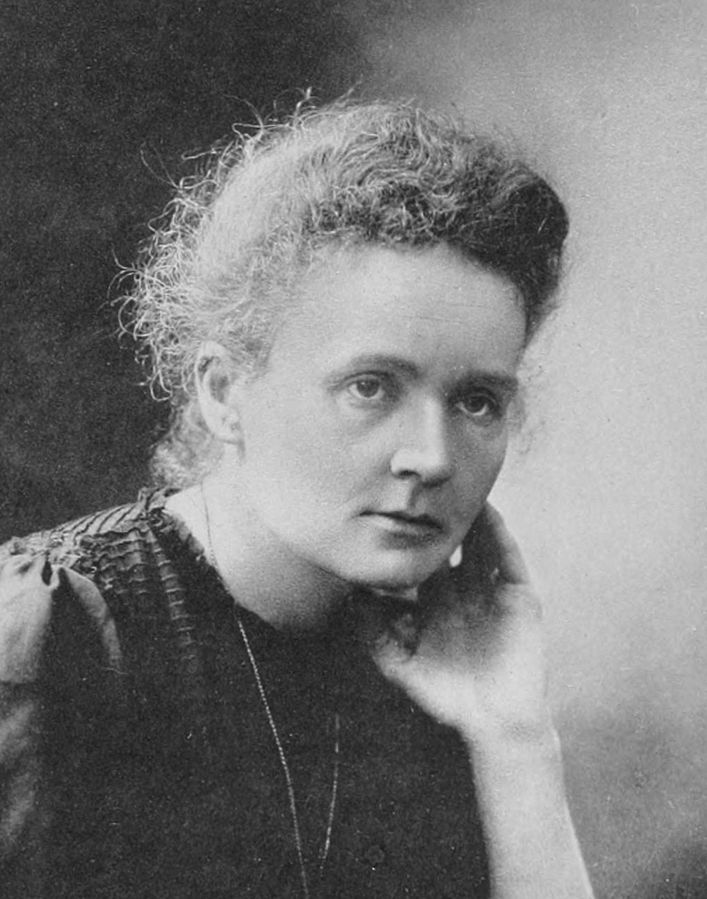
The Laboratory of Vocabulary
(Evening at GERTRUDE STEIN’S Paris home. The night’s salon is coming to a close. As the guests leave, they are still talking excitedly amongst themselves. FITZGERALD and HEMINGWAY exit, in a heated argument. STEIN and LOY watch them go, still seated at the table.)
LOY: Poor boys. How I miss the sight of them arm in arm.
(A pause. LOY begins to move as if she’s preparing to stand and bid STEIN farewell.)
STEIN (suddenly): Do you agree that Marie Curie is the greatest poetic genius of our century?
LOY (sitting back down): Now I know you’re having fun with me.
STEIN: Not at all, dear. Did you hear Williams summarizing her latest discovery? The woman is an artist. Wouldn’t a chemist be the truest model of poetic genius for our age?
LOY (playfully): A poet of science? There are times, my dear Stein, I am thankful I do not share your wonderful imagination.
STEIN: My dear, Curie has transformed the medium in which she works. She creates, interprets, combines, and breaks apart, equally regarding and scorning the conventions of the past. Undeniably, one finds her at the advance guard of her peers.
LOY: From where do her creations arise? Marie Curie does not create, she represents things which existed before she did. And I know your response, friend – that she breathes new life and insight into what preceded her and in doing so, manifests something new. You’re going to say this makes her as much a poet as Pound. But, my dear gadfly, perhaps the intricacies and poetic resonances she discovers would have existed without her insight.
STEIN (more passionate, not upset): We agree, she uncovers fixtures of the natural universe, truths outside her control. But how does she bring these truths to the public? How can it be that dear Williams can share her glowing insights with us? Curie reveals what she discovers through language. She must translate the physical into the symbolic. She manifests nature into text, a feat easy to begin but difficult to achieve.
LOY (amused): I see, she’s Shakespeare’s heiress because she can write an article? Darling, I must reveal to you that she shares this talent with every student at university.
STEIN: It is not simply her use of language that sets her apart. You’re right – any imbecile could write at length about anything.
LOY: No need to elaborate, dear. We are both familiar with my former husband’s work.
STEIN: Well, yes. (thinking for a moment) No, what brings Curie into our fold is her poetic ear. You have said yourself that the new poetry is a response from the poet’s mind to the beauty of the world that surrounds him (Loy 158).
LOY: So she represents her world as a painter does.
STEIN: Not merely represents, she interprets the living world, masses of shifting organic elements and dispositions whose interplay dictates physical laws, just as passions govern the consciousness. But her true artistry arises from her choice of revelation. She does not merely report whatever she sees, but she extracts that which, through the lens of her sensibilities, would bring the most dynamic change to her field, her world. In her representations, she imparts something new.
LOY (nodding): Her approach brings something more original than holding a mirror to her surroundings.
STEIN: Yes! Doesn’t a poet extract a concentrated vial of truth from the well of the world?
LOY: She brings us the poetry of distilled insights, you say.
STEIN: I do.
(A pause. STEIN watches LOY’s face.)
STEIN: You are not convinced.
LOY: Quite the opposite. In the morning, I shall take the first train to Stockholm and demand a prize in literature be added to Curie’s distinctions in physics and chemistry.
STEIN: Now who’s making fun? My dear, I am serious.
LOY: Of that I am convinced. I am also convinced you’ve had enough to drink tonight.
(End scene.)
Work Cited:
Loy, Mina. The Lost Lunar Baedeker Poems. Edited by Roger L. Conover, Farrar Straus and Giroux, 1996.
Image credit: http://www.nobelprize.org/nobel_prizes/chemistry/laureates/1911/marie-curie.html, published in 1912 in Sweden in Les Prix Nobel, p. 64 (Link)
Image accessed through www.creativecommons.org

.jpg)
I love this explanation of what Curie (and Stein and Loy) do: “Curie has transformed the medium in which she works. She creates, interprets, combines, and breaks apart, equally regarding and scorning the conventions of the past.” Terrific job bringing to life the thought processes that make avant-garde innovations intelligible.