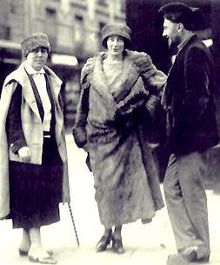
A Beautiful Day in the Village
MINA LOY is walking through the East Village one beautiful morning in the summer of 1920. Heads turn as she passes, which gratifies her. Should their eyes be following her self-designed outfit, it bodes well for her income, should their eyes be following her for her beauty, it bodes well for her ability to continue fulfilling her evolutionary imperative, and should eyes be following her out of shock or outrage, it bodes well for nothing in particular but adds a spring to her step none the less.
STEIN: MINA!
Loy turns as she hears her name, smiling at the irony of her head being the one to whip around, and sees GERTRUDE STEIN walking quickly in her direction from the corner.
LOY: Well, if it isn’t the lady of Radium. [1]
STEIN: I’m flattered, dear, as I was by your poem, but I’m afraid radium isn’t quite what I care to write about.
LOY: And yet with your ability to draw it out, I haven’t the slightest doubt you could do it.
STEIN: Well perhaps I could, but I daresay I could not do it well. To the contrary, radium is precisely beyond the capture-able world. You talk of radium as essence, as core. Such things we can only merely suggest. There is no way to capture something so effervescent as that.[2]
LOY: Well there are many things in life that we needn’t capture, and truly, talented though we may be, that we cannot capture, but we can bring to life nonetheless.
STEIN: No, no, when we mean to create something, often our greatest flaw is that there is too much suggesting, too much remembering, too much past and future and not enough depiction.[3]
LOY: I daresay certain things are best depicted through a little bit of remembrance of the past or hope for the future. I daresay there are a number of pitiable women going mad trapped in their virginal shells who read about intercourse and pleasure without any memories or hopes of any such pleasures of their own.
STEIN: But you cannot think you are capturing that pleasure on the page.
LOY: Oh goodness, no, the whole problem is that such things are captured too often. Locked away where they might not corrupt a corrupted structure. We need only to create an experience that can set the captured free.
STEIN: You do have quite your own way of looking at the world.
LOY: I should think I’d be insulted if you didn’t think so. I should think I’d be insulted if you didn’t think I was such that the world might think me mad. But I shall think you as such that you may be seen as mad, and we’ll the best of friends because of it.
[1] Reference to Loy’s poem “Gertrude Stein” Lost Lunar Baedeker p. 94
[2] Reference to Gertrude Stein’s commentary on how to capture all of the elements of a thing in her writing without falling into the trap of being influenced by remembering, as quoted in the note in the 1997 Dover Publications edition of Tender Buttons.
[3] Ibid.

Brilliant and perceptive, Ellie! I love sensitivity to Loy’s interest in fashion and desperate need for financial survival, as well as the subtle implication that Loy was more of an essentialist and Stein a constructionist. But it’s the word play on “capture” that gets at the double-edged sword of the avant-garde drive to grasp something essential to the self outside social constructions–because when it’s captured, it’s contained, which is the problem in the first place.