Gabrielle Buffet-Picabia
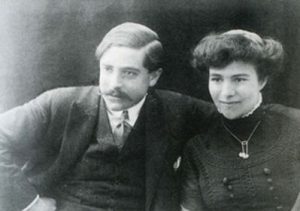
Francis Picabia and Gabrielle Buffet-Picabia
https://www.picabia.com/about-picabia
Gabrielle Buffet-Picabia might be the most quoted figure of the avant-garde, yet she is one of the least studied. Her name is most often found in the footnotes of books, next to citations for her detailed comments and stories on the charismatic male leaders of the Dada movement*. She was born in France in 1881, and grew up with musical aspirations and attended Schola Cantorum, a liberal and controversial center of music in France, directed by Vincent d’Indy. While she was studying and practicing music, d’Indy became an influence on Buffet’s liberating and daring practices, which she carried into her writing and art criticism later in life (Kamenish 39). Between 1908 and 1909, Gabrielle Buffet met and married Francis Picabia. In his analysis of Francis Picabia’s life, William Camfield discusses how Buffet influenced and even accelerated Picabia’s desire and transition to produce more imaginative, reflective, and radically abstract modern art. However, Picabia’s most influential artist relationship was with Marcel Duchamp, whom the Picabia’s first meet around 1910. Buffet asserts in multiple quotations that Duchamp and Picabia should be considered the primary innovators of Dada. Buffet described their relationship: “‘their difference of temperament and conception… drove them to the limits of logical decomposition. They became engaged in an extraordinary contest of paradoxical and destructive statements, words of blasphemy and inhumanity that did not merely attack the old myths of art but the very foundations of life in general’” (Gibson).
Scholars value Buffet most for her “refreshingly unprejudiced analysis of the period,” but she also had many other noteworthy works including “scholarly analyses of contemporary music and art…to an experimental prose and verse” (Kamenish 40, 47). In pieces like her “Petit Manifeste,” with lines such as, “that frightening noise is the beating of your heart,” it is evident that Buffet’s writing embodies “the teasing spirit of Dada” (Kamenish 46). Additionally, in two of her essays, “Arthur Cravan and American Dada” and “Some memories of Pre-Dada: Picabia and Duchamp,” Buffet mirrors the form of her writing with the subject of her writing. Her essay on Arthur Cravan concludes with the words: “the end of this amazing figure will never be cleared up” (Motherwell 17). And, the essay about Picabia, Duchamp and Dada (or what came to be known as pre-Dada), ends with the reflection of “Dada vanished one fine day” (Motherwell 267). Both pieces end with an uncertain and inconclusive feeling, just as the subjects of the essays have. By doing so she embraced the very nihilistic spirit she described the 391 publication as having, because the publication was “‘without other aim than to have no aim’” (Hofmann).
The social atmosphere of the avant-garde and Dada movement sounds like the transition scenes from movies: lots of people, noise, thick air, drinking and conversations. Scholars refer to many of the social circles during the avant-garde by who was in them or where they would congregate. Buffet and Picabia were involved with the artists and writers who gathered at “33 West Sixty-seventh Street,” otherwise known as Louise and Walter Arensberg’s apartment (Burke 213). Larry Witham delves into the habits at these gatherings and asserts that “art, sex, and alcohol” and “chess” became the language in Arensberg’s circle (114). Buffet and Picabia without a doubt first attended Arensberg’s apartment as guests of Duchamp, and this is most likely the setting in which Buffet and Mina Loy became acquainted – as well as many other artists including, Arthur Cravan, Germaine Everling (Picabia’s mistress), Edgard Varése, Albert Gleizes and wife Juliette Gleizes, Juliette Roche, Jean Crotti, Suzanne Duchamp, Pan Ray, Joseph Stelle, Morton Schamberg, and everyone who gathered at Louise and Walter Arensberg’s place (Kamenish 41).
An area that Buffet and Loy seemed to bond over was in their questioning of Duchamp’s intentions in some of his scandalous and harsh remarks about women (Burke 217). Though their opinion of a man may have bonded them, ironically, their relationship ended over their opinion of another man, Arthur Cravan, with whom Loy had a romantic relationship with. After Buffet “published a memoir of Cravan that was largely complementary but expressed doubt about the reasons for his disappearance, Mina cut her dead” (Burke 381). Additionally, in the same piece Buffet wrote that Loy told her that she went searching for Cravan when he disappeared. Loy and Buffet were not best friends, however, it is apparent that the Arensberg circle was small enough that they talked about each other’s intimate lives.
In Buffet’s later years, she participated in the French Resistance and sheltered Allied parachutists and escaped prisoners of war, and hid documents for the Belgian secret service (Kamenish 51). Despite her political and other passions later in life, Buffet is most remembered and praised for her “invaluable reflections on the rise and spread of the avant-garde on both continents” (Kamenish 38). Her work is successful and interesting in providing professors, students, and scholars internationally a window into the social, cultural, and political world of primary figures during her lifetime.
