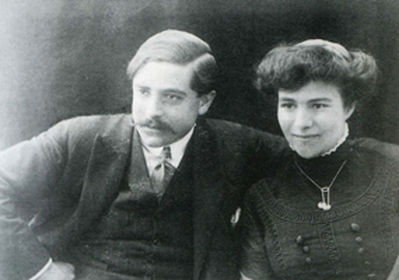
Gabrielle Buffet-Picabia: Eyes of the Avant-Garde
Gabrielle Buffet-Picabia might be the most quoted figure of the avant-garde, yet she is one of the least studied. Her name is most often found in the footnotes of books, next to citations for her detailed comments and stories on the charismatic male leaders of the Dada movement.
She was born in France, in 1881 and grew up with musical aspirations and attended Schola Cantorum, a liberal center of music in France, directed by Vincent d’Indy. While she was studying and practicing music, d’Indy inspired her to practice liberating and non-traditional forms of music, which she carried into her writing and art criticism later in life.
Gabrielle Buffet met Francis Picabia in 1908 and they were married in 1909. Buffet influenced and accelerated Picabia’s desire and transition to produce more imaginative, reflective, and abstract art. In 1910, not long after the Picabia’s married, they first met Marcel Duchamp, who became a long term friend, with whom they had an artistic and personal relationship. Buffet credits the two men for inventing Dada.
Scholars value Buffet most for her unbiased and unselfish analysis of the period, but also for her “experimental prose and verse” (Kamenish 47). Buffet’s writing embodies the teasing spirit of the Dada movement, especially in pieces like her Petit Manifeste. Additionally, in two of her essays, “Arthur Cravan and American Dada” and “Some memories of Pre-Dada: Picabia and Duchamp,” Buffet reflects the ambiguity and playfulness that characterized Dada. Both of these essays end without a solid conclusion, and the fate of the subject of each is also left uncertain.
Often the social atmosphere of the avant-garde and Dada movement involved lots of people and drinking, especially at places like the Arensberg apartment; this most likely where Buffet and Mina Loy first met. Many avant-garde artists and writers gathered at the home of Louise and Walter Arensberg in New York. Buffet and Picabia first attended Arensberg’s apartment as guests of Duchamp. Here Buffet would have become acquainted with Mina Loy, and other artists including, Arthur Cravan, Germaine Everling (Picabia’s mistress), Albert Gleizes and wife Juliette Gleizes, Man Ray, and many more (Kamenish 41).
Although there is not much evidence of a close friendship between Buffet and Loy, they agreed that Duchamp’s intentions in his scandalous and harsh remarks about women deserved questioning. Ironically, their opinion of a different man, Arthur Cravan, whom Loy had a romantic relationship with, ended any friendship they had. After Buffet “published a memoir of Cravan that was largely complementary but expressed doubt about the reasons for his disappearance, Mina cut her dead” (Burke 381).
In Buffet’s later years, she participated in the French Resistance and sheltered Allied parachutists, escaped prisoners of war, and hid documents for the Belgian secret service. Despite her political passions later in life, Buffet remains to be praised for her “invaluable reflections on the rise and spread of the avant-garde on both continents” (Kamenish 38). Her work is successful in providing professors, students, and scholars internationally a window into the social, cultural, and political world of primary figures during her lifetime.
Bio Template:
-
- Name – Gabrielle Buffet-Picabia
- Date of Birth – 1881 (Kamenish 37)
- Place of Birth – France
- Date of Death – 1985 (Kamenish 37)
- Place of Death – France
- Country of origin, citizenship – France
- Gender – Woman
- Race – French
- Kind of Artist/Cultural worker – Musician, art critic and writer
- Address in Florence or New York – There was not a specific address found. However, Picabia (and therefore Gabrielle) was said to have spent time with Alfred Stieglitz at his Gallery 291 on Fifth avenue (Francis Picabia: Biography). Additionally, she and her husband are known to have been at Arensberg’s apartment (Burke 213).
- Dates & Places of Overlap with Loy:
- They might have met as guests at Arensberg’s apartment at “33 West Sixty-seventh Street” (Burke 213). This is likely because it is known by various sources that they both attended at some point, additionally, they both were friends of Duchamp, who often had french friends attend.
- “After Gabi Picabia published a memoir of Cravan that was largely complementary but expressed doubt about the reasons for his disappearance, Mina cut her dead” (Burke 381). The Arensberg circle was clearly close enough that they knew intimate details about each other.
- Avant-garde movements the figure was associated with – Most prominently, Dadaism. She “witnessed and recorded the birth, evolution, and demise of Parisian Dada” (Kamenish 38).
- Biographical/Historical significance – She is often thought of as, Francis Picabia’s wife, however, she is quoted very, very often when discussing avant-garde artists because of her descriptive observations. Additionally, during WWII she and her daughter Janine were involved in the Resistance movement; she sheltered Allied parachutists and escaped prisoners of war, and hid documents for the Belgian secret service (Kamenish 51).
- Figure’s Relationship to Loy: They appear to be no more than friends in the same circle, who turned into enemies (at least in Loy’s eyes).
- What was the nature of their overlap or connection? Loy and Buffet appear to have been acquaintances through their connection of Duchamp and the Arensberg circle.
- Was it social, literary, artistic? Were they involved in collaborative ventures? I have not found any evidence of them collaborating, however, they seem to have similar perspectives when it came to Duchamp’s work, for they were “the only ones to question [Duchamp’s] intentions” regarding his harshness towards women at times (Burke 217).
- What other artists/writers did your figure come in contact with?
- Guillaume Apollinaire – Luna Park, France, May 1914 (Adoc-photos)
- Francis Picabia
- Marcel Duchamp
- Arthur Cravan
- Germaine Everling (Picabia’s mistress)
- Edgard Varése (music school and apartment)
- Mina Loy
- Through connection of Duchamp – Albert Gleizes and wife Juliette Gleizes, Juliette Roche, Jean Crotti, Suzanne Duchamp, Pan Ray, Joseph Stelle, Morton Schamberg, and everyone who gathered at Louise and Walter Arensberg’s place (Kamenish 41).
Works Cited:
Adoc-photos. “Francis Picabia, Gabrielle Buffet and Guillaume Apollinaire.” Getty Images, Corbis Historical, 1 May 1914, www.gettyimages.co.uk/detail/news-photo/photo-postcard-showing-francis-picabia-gabrielle-buffet-and-news-photo/526887100#photo-postcard-showing-francis-picabia-gabrielle-buffet-and-guillaume-picture-id526887100.
Burke, Carolyn. Becoming Modern: the Life of Mina Loy. Harper Collins Canada Ltd., 1996. Print.
Camfield, William A. Francis Picabia: His Art, Life and Times. Princeton University Press, Princeton, New Jersey, 1979, pp. 14, 15, 17, 91, 92, 105, 110, 112. Print.
Craft, Catherine. An Audience of Artists: Dada, Neo-Dada, and the Emergence of Abstract Expressionism. The University of Chicago Press, 2012, Chicago, pp. 19-24. Print.
“Francis Picabia: Biography.” Site Officiel De Francis Picabia, The Picabia Committee, 2016, https://www.picabia.com/about-picabia.
Gibson, Michael, and International Herald Tribune. “Francis Picabia, Awful Artist and Provocateur of Genius.” The New York Times, The New York Times, 21 Dec. 2002, http://www.nytimes.com/2002/12/21/style/francis-picabia-awful-artist-and-provocateur-of-genius.html.
Hofmann, Irene E. “Documents of Dada and Surrealism: Dada and Surrealist Journals in the Mary Reynolds Collection.” The Art Institute of Chicago Ryerson and Burnham Libraries, The Art Institute of Chicago, Apr. 2010, http://www.artic.edu/reynolds/essays/hofmann.php.
Kamenish, Paula K. Mamas of Dada: Women of the European Avant-Garde. University of South Carolina Press, 2015. Print.
Motherwell, Robert, editor. The Dada Painters and Poets: An Anthology. Wittenborn, Schultz, Inc., 1951, pp. 13-17, 255-267. Print.
Pearlstein, Philip. “When the Dada Daddies Got Real; Or, How I Turned Picabia Inside Out.” The Brooklyn Rail, The Brooklyn Rail, 1 Feb. 2017, http://brooklynrail.org/2017/02/art/When-the-Dada-Daddies-Got-Real-Or-How-I-Turned-Picabia-Inside-Out.
Terraroli, Valerio, editor. “The End of the Artistic Object – Dada Revolution.” 1900-1919 the Avant-Garde Movements. Skira, Italy, 2006, pp. 388, 389. Print.
Witham, Larry. “Parisian in America.” Picasso and the Chess Player. University Press of New England, 2012, pp. 112-118, https://books.google.com/books?id=6xkkSVZz_OYC&pg=PA114&lpg=PA114&dq=gabrielle+buffet+picabia+arsenburg+apartment&source=bl&ots=nF05rHy7mu&sig=FLuNuCGcFvKW-c8gpQyIDyZMBAM&hl=en&sa=X&ved=0ahUKEwi1nu_k-6XWAhWo5lQKHdUiB5UQ6AEIUTAM#v=onepage&q&f=false.
