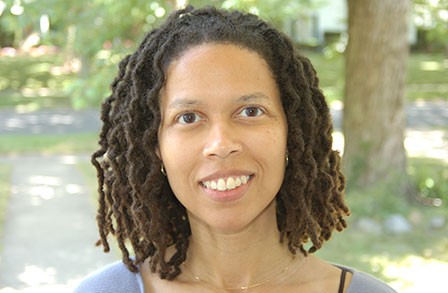
Lit Review, Evie Shockley by Grady & Abbey
Grady Pearson and Abbey Corcoran
Dr. Churchill
English 394
November 3, 2017
Secondary Source Reports:
MLA Citation: Booze, Elizabeth. “the new black by Evie Shockley.” The Hollins Critic. Volume 52, Number 3, June 2015. pp. 18-19.
Thesis:
- “While the collection has been called a powerful reimagining of blackness in America, I would instead label it a call to think of blackness more broadly and complexly” (Booze 18).
- “While the new black does not offer a singular re-definition of blackness, it knowingly and thoughtfully speaks up into ongoing conversation around the black American identity, and pokes and prods at our conceptions of not only race, but also place, womanhood, institutions and corporations” (Booze 18).
Paraphrase:
Though her piece is a short one, Booze posits a complex and multi-pronged thesis in which she asserts that Evie Shockley’s new collection of poetry the new black does not provide readers with one new conception of blackness but, rather, seeks criticize the singularity of our current conception of blackness and to expand how we think of it, especially in relation to other identities and “the state of the racial landscape” (18).
Structural Outline:
- Booze begins with a short section that introduces Shockley and the new black as the focus of her piece.
- Thesis: “While the collection has been called a powerful reimagining of blackness in America, I would instead label it a call think of blackness more broadly and complexly” (18).
- The section directly following the thesis offers some preliminary evidence, which Booze provides vis-à-vis a close reading of one of Shockley’s poem “getting around utopia”, which—she argues—represents the “disillusionment that characterizes the book”, perhaps a disillusionment the narrow conception of blackness Booze argues Shockley takes on (18).
- Following the close reading, Booze posits the second half of her thesis, arguing that the new black “thoughtfully speaks up into ongoing conversation around the black American identity, and pokes and prods at our conceptions of not only race, but also place, womanhood, institutions and corporations” (18).
- Booze summarizes the themes and forms of Shockley’s poetics in the collection to illustrate how Shockley’s work questions contemporary systems by reimagining “the voices and lives of submerged people and places” (18).
- Finally, Booze analyzes the poem “dependencies” to illustrate Shockley’s use of these submerged voices (Thomas Jefferson’s “dependents”) and her critique of American systems that perpetuate inequality through her inclusion of lines from the Declaration of Independence.
- The work concludes with Booze’s review-esque call to read the new black if the reader is looking for a “masterful exploration of what we talk about when we talk about race, place, and womanhood” (19).
Rhetorical Strategies:
- Often, as writing gets more complex, so do the theses. I like the way Booze splits her thesis and releases it in parts (in the 1st and 2nd paragraphs). I think this would be a successful strategy for a longer literary criticism where the argument builds on earlier paragraphs and close readings.
- I really like the phrase “submerged people and places” and, I think it is a linguistically beautiful way to talk about silenced narratives, especially narratives surrounding African American identity and the importance of the ocean and the middle passage (Booze 18).
- Although Booze’s summary in section five is an effective way to introduce the reader to the themes and questions that drive Shockley’s work, it would be even more effective couples with particular reads on some of Shockley’s poems. In my own essays, I would back up instances of summary with textual evidence.
MLA Citation: Vrana, Laura. “‘SOUNDTRACK FOR A GENERATIONAL SHIFT’: Music & Innovation in Evie Shockley’s the New Black.” Obsidian 41.1 (2015). ProQuest. Web. 28 Oct.
Thesis:
- “the new black, through formal innovation, unravels assumptions about authentic Black poetry being influenced by Black music and orality […] the text advocates for plural, multitudinous Black poetics” (1).
- “…arguing for a murky definition of blackness…” (3).
- “…highlighting the importance of writing histories that center on women rather than always foregrounding male figures or heterosexual love” (4).
Paraphrase:
Vrana argues that Shockley’s the new black reimagines blackness as murkier, broader, defined by more than Black orality and music and, more accessible to and shaped by Black women poets than it has been considered in the past. Vrana also claims that presence of the new black indicates that we should anticipate more Black women poets like Shockley will be perpetuating this new blackness in the future.
Structural Outline:
- Vrana starts her critical essay off with a hook, in the form of an epigraph: “[W]e must be willing to look beyond the ‘recognizably black’ in search of black aesthetics” which she cites as a quote from Evie Shockley herself.
- In the second section, Vrana defines key terms—such as “son-nots” which “look like sonnets but they’re not” and are often preset in Shockley’s work.
- In the third section, she engages in a close reading of one of Shockley’s poems from the new black (“my last modernist poem, #4 (or, re-re-birth of a nation)”). In this section, Vrana uses her analyses to argue that Shockley’s use of allusions and repetition in “my last modernist poem” demonstrates “the inevitable repetitiveness with which the racialized discourses reappear throughout American History” (1).
- After the close reading, Vrana posits her thesis.
- Following her thesis, Vrana provides a roadmap for the remainder of the essay saying, “I argue first through close attention to several poems that Shockley’s adaptation of music constitutes a vital change to the authenticity discourses that still haunt black poetry criticism” and “[s]econd I argue that Shockley’s practices deserve our attention” to further the definition of innovation in the field of Black poetry (1-2).
- In the ensuing paragraphs, Vrana summarizes theory from Shockley’s critical text Renegade Poetics.
- Vrana goes on to close read four of Shockley’s poems, “bop for presidential politics”, “soundtrack for a generational shift”, “x-marks the spot”, and “mesostics from the american grammar book” and using each poem to further her argument that Shockley’s new black goes beyond Black music and orality and masculinity in its engagement of black aesthetics.
- In her analysis of “x marks the spot” Vrana uses Cindy Lyles’s theory on the layout of the poem to further her argument.
- Vrana concludes by summing up her argument and by stating that innovation in the black poetic tradition is not a new development but, could be reimagined to be a broader “strategy” for African American writers (6).
Rhetorical Strategies:
- I like how she started out with a close reading of “my last modernist poem” before positing her thesis. It really framed her argument and, by the time she had stated her thesis I, as a reader, was already on the same page with her regarding what she was going to be looking at and arguing.
- Vrana’s argument is very convincing, in part because of the amount of textual analysis she does. Each different poem she analyses lends itself to a different part of her argument, which is something I would definitely like to replicate in an English essay.
- Something that I always struggle with in essays where I employ a theoretical lens is how and when to introduce my theory. I always tend to posit it in my introduction, which clutters up my reader’s access point. Vrana, in her use of Cindy Lyles’s theory, does not introduce it until the point of her essay where she uses it, which is something I could use in the future in a critical or historical essay.
MLA Citation: Thorsson, Courtney. “Foodways in Contemporary African American Poetry: Harryette Mullen and Evie Shockley.” Contemporary Literature, vol. 57, no. 2, 2016, pp. 184–215., doi:10.3368/cl.57.2.184.
Thesis: “Foodways—ways of doing culinary work and routes that foodstuffs travel—are a tool for formal innovation and thematic exploration of identity in African American literature from its beginnings to the present. In their poetry of the past few decades, Harryette Mullen and Evie Shockley use the recipe form and culinary discourse to write vernacular poetry without relying on the formal innovations of their predecessors” (Thorsson 184).
Paraphrase: Examining the ways African American writers represent food in literature presents a useful study of how food has shaped historical and present conceptions of black identity. Harryette Mullen and Evie Shockley adopt the conventions of these “foodways” in their poetry, interacting with the historical legacy of black culinary culture while forging wholly new innovations.
Structural Outline:
- Thorsson traces Mullen and Shockley’s innovative use of foodways that differentiate them from the conventions of their predecessors. Her thesis supports Erica R. Edwards’ claim that twenty-first century African American writers simultaneously connect to and distinguish themselves from previous cultural traditions. Mullen and Shockley share the use of foodways, drawing upon the language and practices of a larger tradition, while distinguishing themselves by allowing the forms of their poems to differ greatly while questioning previous notions of singular blackness. While both poets use the recipe form in their work, invoking a wealth of cultural markers and practices attributed to notions of a coherent black identity, while employing formal innovations and voicing critiques that complicate and criticize those notions of uniformity.
- Thorsson next cites Shockley’s 2011 critical work Renegade Poetics: Black Aesthetics and Formal Innovation in African American Poetry, which outlines “a plural, lowercase “black aesthetics”” unmoored from a singular, prescriptive black identity (185). “Culinary language and the recipe form” both illustrate one of the infinite routes of black expression (185).
- In introducing Harryette Mullen’s work, Thorsson references Allison Cumming’s argument from her 2005 article, “Public Subjects: Race and the Critical Reception of Gwendolyn Brooks, Erica Hunt, and Harryette Mullen.” Cumming claims that Mullen’s works display a progression from a unified black voice to a fragmented subject to a collection of cultural voices. Thorsson challenges Cumming, arguing that Mullen’s use of foodways throughout her work indicate she remains anchored in an African American vernacular tradition even as she embarks on unconventional innovations.
- Shockley’s use of foodways focuses on the pivotal role of African American identity, “especially black labor” in the history of the United States, distinguishing her work from Mullen’s (204). Thorsson examines poems from Shockley’s A half-red sea and the new black to trace these connections, ultimately finding that foodways “oscillate between national identity and personal experience” in Shockley’s poetry, illustrating Shockley’s concept of a “complicated and multiple blackness” (212).
MLA Citation: Collins, Martha. “the new black, Evie Shockley.” FIELD: Contemporary Poetry and Poetics, Spring 2012.
Thesis: “…some African American poets themselves have recently looked back and shown us that much African American experimental poetry is in fact rooted in the use and subversion of form.” “Shockley’s own new book of poems exemplifies this fusion of the formal and innovative…the new black includes love poetry and poems in narrative and epistolary modes that provide accessible moments of relief against the more demanding work” (“the new black, Evie Shockley”).
Paraphrase: Evie Shockley’s the new black is emblematic of the subversive tradition of African American experimental poetry, presenting poetic conventions both in accepted forms and innovative reversals.
Structural Outline:
- Martha Collins introduces her review of the new black by contextualizing it in a space between traditional forms of poetry adopted by black writers and “a less-noticed but equally important flowering of innovative African American poetry” (“the new black, Evie Shockley”). Shockley’s work exists in between these camps, relying on the vocabularies and structures of traditional poetry while embracing the “subversion of form” that characterizes the work of African American writers of experimental poetry.
- Collins creates an inventory of the traditional forms Shockley adopts in the new black, including “three rhymed sonnets and fourteen unrhymed ones… a sequence of haiku, two ghazals, a poem in rhymed quatrains, and a sestina…” as well as poems using mesostics, acrostics, and other literary structures. “But even when she’s using these forms,” Collins argues, “– or perhaps especially when she’s using them – Shockley is subverting them in ways that make them among the book’s most stunningly innovative and deeply challenging forms” (“the new black, Evie Shockley”).
- Drawing on several examples including the word collage sestina “clare’s song” and the “recently invented” gigan “celestial,” Collins identifies the influence of “word work” and “mental energy,” two experimental strategies that give Shockley’s poetry its sense of subversive innovation. “Word work” describes the text’s “playful… language-driven moves” that impart a flowing seamlessness between subjects. The “expenditure of mental energy” present in the new black’s more challenging features is a technique suppressing “the tenor of a metaphor altogether,” characterizing the obscure “dear white xmas” and “my life.” As abstract as these examples may be, they retain “references past and present” and unite the speaker’s life “and the life of a people,” demonstrating Shockley’s conception of multifaceted, interconnected but not monolithic black aesthetics (“the new black, Evie Shockley”).
Literature Review:
In her 2011 book Renegade Poetics: Black Aesthetics and Formal Innovation in African American Poetry, Evie Shockley calls for renewed “black aesthetics,” resisting essentialist conception of blackness established by the formative, but monolithic Black Arts Movement. Shockley’s “black aesthetics” embraces the diverse range of expression available to black writers, celebrating plurality and rejecting the prescriptive notion of the transcendent black soul. Renegade Poetics invites black artists to define their identity themselves rather than conforming to an essentialist model.
If Renegade Poetics is the theoretical foundation of Shockley’s black aesthetics, the new black puts that theory into practice. Sweeping and historical while simultaneously personal, the new black portrays individuals ranging from Jefferson’s cook James Hemings, to Ella Fitzgerald, to a pensive speaker rectifying childhood nostalgia for the South with its history of oppression. While Shockley’s poems draw from a shared historical and cultural vocabulary, none prescribe a fixed, universal blackness, rather embracing each subject as a distinct identity with varying means of agency and self-expression. Published in 2011, the new black has not had long to become the subject of criticism and analysis. Nevertheless, the analysis that is available is diverse, centering around Shockley’s varying adherence to poetic forms, her experimental innovations, and her portrayal of blackness as either disparate or offering collective identity.
The poems of the new black are as diverse as their subjects, some relying on conventional forms such as the sestina and haiku, while others are dense chunks of text or jumbled, non-aligned polyvocal discourses between three or four speakers. This plurality of poetic forms has inspired several critics to question whether Shockley adheres to or resists conventional forms. In “Black Women Poets by the Numbers: Evie Shockley and Allison Joseph,” Briana Whiteside argues Shockley’s poems are primarily innovative. While she claims that “Shockley’s use of person aligns her with large numbers of past and contemporary poets,” she also emphasizes the visual innovations of Shockley’s poems, distinguishing them from the works of other poets she analyzes (67). These illustrative designs offer a unique “alternative to reading standard poetry in verse and meter” (62). Whiteside describes Shockley as an innovative poet, but she does not deny her place within a larger context of poets of color experimenting with form. While the designs of Shockley’s poems “position her within a larger network of writers” who also experiment with form, Whiteside argues the poems are fundamentally “nonconventional” and “challenge readers to analyze… appearance” as well as words (70).
Courtney Thorsson’s 2016 article “Foodways in Contemporary African Poetry: Harryette Mullen and Evie Shockley” traces how black authors generate formal innovations and portray identity through foodways, or “ways of doing culinary work and routes that foodstuffs travel” (184). Thorsson’s argument casts Shockley’s work as experimental as well as a fusion of the formal and the innovative. She begins by arguing Shockley and Mullen adopt conventions from “recipe form and culinary discourse” in their poetry “without relying on the formal innovations of their predecessors” (184). Thorsson and Whiteside agree that Shockley’s work distinguishes her from previous traditions, yet Thorsson does more to connect Shockley with other poets than Whiteside, who only concedes that Shockley shares similarities with other experimental poets. As Thorsson examines Mullen and Shockley’s poetry, she identifies examples of “culinary and recipe form” that present an intersection of the conventional and the experimental (185). Thorsson concludes that it is Shockley’s notion of “complicated and multiple blackness” that makes her work innovative, communicated through established forms, yet presented in new ways (212).
In her analysis of Shockley’s “where are you planted” for Emerson College’s Ploughshares blog, Ariel Katz accepts the new black as a fusion of the formal and innovative. The poem engages the complexities of southern nostalgia, casting trees as emblematic of both the refuge of home and centuries of lynching and oppression. Tracing the poem’s connections to Billie Holiday’s “Strange Fruit,” Katz argues the poem “mingles measured nostalgia for southern trees with the violence of the history they stood through,” a suspicious, conflicted embrace of one’s roots emblematic of Bowers’ “For the South” as well (Ploughshares). Katz concludes that “where are you planted” adopts a traditional literary form – a lullaby – and gives it a complexity beyond its original form.
Martha Collins makes the most explicit case for the new black as a blend of form and experimentation in her review appearing in the spring 2012 issue of FIELD: Contemporary Poetry and Poetics. She argues Shockley’s poetry resides in the tradition of equal “use and subversion of form” that characterizes much of “African American experimental poetry” (“the new black, Evie Shockley”). Refusing to force the new black into a single category, Collins accepts the work as a blend of traditional and experimental poetic forms, some which reflect convention and others which defy classification.
Shockley herself has challenged the frequent distinction within academic and literary circles between experimental work and work that portrays identity expression. In “Loaded Terms,” a 2012 piece for the Boston Review, Shockley communicates the danger of dividing poetry into dichotomies which discourage expansive vision. As her poetic work illustrates, she aims to erase boundaries and distinctions that dictate poets of color are not suitably experimental simply because they write about their expressions of race, gender, and other aspects of identity. She calls on other poets to resist re-institution of the “wide-reaching binaries that have structured “Western thought” for thousands of years” (Boston Review).
Just as critics have debated innovation in Shockley’s poetry, recent criticism focusing on Shockley’s newest collection, the new black, interrogates and debates whether Shockley’s collection actually does imagine a new black or, in other words, a new conception of blackness. Elizabeth Booze was the first to write on this topic in her 2015 review in the Hollins Critic. In her article, Booze argues that Evie Shockley’s the new black does not provide readers with one new conception of blackness but, rather, seeks to criticize the singularity of our current conception and conceive of it “more broadly and complexly” in the future, while still keeping it within the bounds of the current paradigm of blackness (Booze 18). Booze bases this argument on Shockley’s placement of blackness in conversation with “place, womanhood, institutions, and corporations” in poems like “dependencies” and “the cold”, which she claims illustrates that the new black does not represent a “re-imagination of blackness in America” but, rather, an expansion of blackness to include ideas like those of place and womanhood (18).
Articles by Laura Vrana (2015) and Thomas Fink take oppose Booze’s argument and posit that Shockley’s volume does reimagine blackness, or at least anticipates a coming reimagining. In “‘SOUNDTRACK FOR A GENERATIONAL SHIFT’: Music & Innovation in Evie Shockley’s the new black” Vrana argues that the new black reimagines blackness as murkier, broader, defined by more than Black orality and music and as more accessible to and shaped by Black women poets than it has been considered in the past. Vrana close reads several of Shockley’s poems to show how they conceive of womanhood and orality differently from traditional how conceptions of blackness do. For example, Vrana uses Shockley’s “soundtrack for a generational shift” to support her argument that, “[t]o expand definitions of the innovative in Black poetics that incorporate only certain varieties of musically influences works, Shockley uses some of her wildly visually experimental pieces that do not explicitly incorporate musicality to deal with themes and concerns typically expected of musically innovative Black poems” (3). Although much more focused on the “narrative and imagistic (at times ekphrastic)” strategies Shockley employs to depict racial and sociopolitical identity, Thomas Fink—in his review of the new black—aligns himself with Vrana when he writes in his conclusion that Shockley’s work may anticipate a “‘new black’ concept to be realized in the future—with luck, the near future” (Fink 45; Fink 49).
An overarching theme or “critical camp” throughout the literature on Shockley’s the new black, which transcends the debate about reimagining blackness, is an interest in how Shockley portrays historical and/or iconic Black figures in her poetry. Fink, for example, describes how Obama, in Shockley’s “my last modernist poem #4 (or, re-re-birth of a nation)” is “a signifier: ‘a clean-cut man brings a brown blackness / to a dream-carved, unprecedented / place. some see in this the end of race” (46). Fink identifies Obama a symbol or even a synecdoche “to answer those who ascribe such gigantic significance to the 2008 election” (46). Further, Fink argues that Shockley’s representation of Obama; “re-emphasizes both social construction and individual agency,” inviting reflection upon “the current power structure” (48). Vrana also mentions how in Shockley’s “(mis)takes one to know one” the imagined conversation between Frederick Douglass and Barack Obama highlights “the collection’s investment in engaging the present with historical context” (2). A third critic, Howard Rambsy III, also engages in a discussion of Shockley’s portrayal of these figures in his essay on Shockley’s use of persona poetry in her poem “from the lost letters of Frederick Douglas”. Rambsy argues that Shockley’s poem differs from typical heroic narratives and instances of persona poetry because it “presents Douglas in a different phase of his life” (553). In Shockley’s poem, Douglas speaks—post-bondage—to his daughter and tries to explain his intimate relationship with a white woman. Of this, Rambsy writes, “Shockley makes the ex-slave a far more vulnerable—and arguably more complex—figure than he is typically portrayed in verse […] Shockley utilizes the persona poem to simultaneously demythologize and diversify views of Douglass’s life” (554). The significance of this debate regarding the iconic figures is in the fact that it serves as a microcosm for the discussion regarding Shockley’s work. In this critical conversation, Shockley’s representations of Obama and Douglas embody or are critically endowed three very separate meanings but, each one is still connected to blackness, poetics, and/or identity. Thus, Shockley’s portrayal of these figures and the critical discourse that comes out of that portrayal is emblematic of the debates happening in critical works on Shockley’s the new black: they differ widely (and there is little chance of reconciliation) but, eventually they all return to the notions of black aesthetics and poetics.
Works Cited:
Booze, Elizabeth. “the new black by Evie Shockley.” The Hollins Critic. Volume 52, Number 3, June
- pp. 18-19.
Collins, Martha. “the new black, Evie Shockley.” FIELD: Contemporary Poetry and Poetics, Spring
2012.
Fink, Thomas. “Questioning Modes of Renewal and Reconstruction: Evie Shockley’s The New Black.”
Denver Quarterly. Volume 46. Number 4. pp. 45-49.
Katz, Ariel. Sinister Trees and Fragrant Flowers. The Ploughshares Blog, Emerson College.
http://blog.pshares.org/index.php/old-southnew-south-sinister-trees-and-fragrant-flowers/. Accessed 17 Oct. 2017.
Rambsy, II, Howard. “Catching Holy Ghosts: The Diverse Manifestations of Black Persona Poetry.”
African American Review, vol. 42, no. 38.
Shockley, Evie. “Loaded Terms.” Boston Review. 6 December 2012.
Shockley, Evie. Renegade Poetics: Black Aesthetics and Formal Innovation in African American
Poetry. Iowa City, University of Iowa Press, 2011
Shockley, Evie. The New Black. Middletown, Wesleyan University Press, 2012. Project Muse,
https://muse.jhu.edu/book/13559/.
Thorsson, Courtney. “Foodways in Contemporary African American Poetry: Harryette Mullen and Evie
Shockley.” Contemporary Literature, vol. 57, no. 2, 2016, pp. 184–215., doi:10.3368/cl.57.2.184.
Vrana, Laura. “”SOUNDTRACK FOR A GENERATIONAL SHIFT”: Music & Innovation in Evie
Shockley’s the New Black.” Obsidian 41.1 (2015). ProQuest. Web. 28 Oct.
Whiteside, Briana. “Black Women Poets by the Numbers: Evie Shockley and Allison Joseph.” Journal
of Ethnic American Literature, vol. 4, 2014, pp. 61–74.

Pingback: princess peach sex games gif