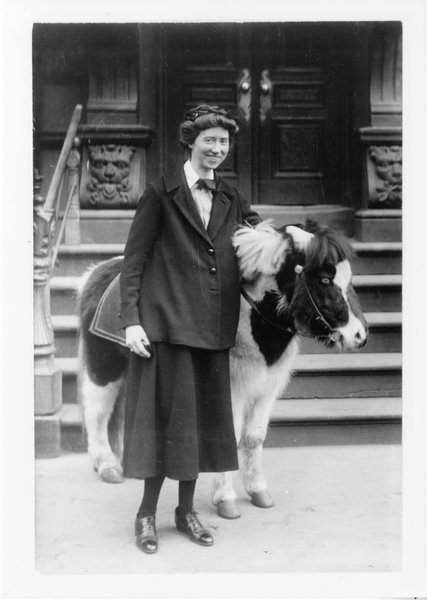
Marianne Moore
750 Word Narrative:
Born in 1887 in the manse of the Presbyterian church in Kirkland Missouri where her maternal grandfather was pastor, Marianne Craig Moore never met her father, who suffered a nervous breakdown and been institutionalized before her birth. Moore, her mother, and her brother lived together (moving sporadically) until 1905, when Moore began attending Bryn Mawr College in Pennsylvania (Gale). It was there that Moore published her first poems and, Hicok argues, developed a feminist rhetoric centered on the notion of the “modern woman” that is later evident in Moore’s poems “Black Earth” and “Peter” (Hicok 485). It was also at Bryn Mawr that Moore began to explore both her infatuation with the biology of animal forms (which later manifested itself in poems like “A Jellyfish”) and her desire for women: interestingly, despite her many relationships with women, Moore herself never called herself a lesbian (Gale, Kent 184).
Moore graduated from college in 1909 and in 1918, after seeing some of her poems published in the avant-garde little magazine Others and taking a trip to visit its publisher Alfred Kreymborg and his circle (including Mina Loy), Moore moved to New York City’s Greenwich Village with her mother (Miller). From 1921-1925, Moore worked at the Hudson branch of the New York Public Library. During her employment at the library, Moore took a trip (1922) to Bremerton, Washington to visit her brother (Hadas). While she was there, Moore climbed Mount Rainer and was inspired to start two of her most well-known poems, “An Octopus” and “Marriage” (Kent). In 1924, an extended book of Moore’s poetry that included fifty-three poems was published in the United States under the title Observations. In the same year, Moore won a $2000 award for achievement in poetry from the little magazine The Dial (Gale).
The time after Moore’s move and before her trip was the time of greatest overlap with Mina Loy. Loy had reportedly disclosed to William Carlos Williams that that during her visit to New York “Marianne was the only one whose poetry she had feared” (Burke 291). Thus, Williams’s decision to construct them as foils in some public remarks he made in 1920 was no accident: a rivalry began but, as Burke tells us in her biography of Loy, mostly because of their male counterparts pitting them against one another ceaselessly. It was suspected, however, that Moore (though her work was comparable to Loy’s) felt inadequate in comparison to Loy’s beauty and presence at literary events. This must have been what presumably prompted her to write “Those Various Scalpels” “about Mina’s image[1] in literary circles” (Burke 292). While Loy and Moore preferred to keep their distance (as indicated by the by Moore’s narrator’s distance in “Those Various Scalpels”), in January of 1920, Mina and McAlmon did visit Moore in Greenwich Village. There is not much written about that meeting but, it was later restaged in McAlmon’s Post-Adolescence. Despite what McAlmond tells us was an awkward meeting and a forced rivalry, it was ultimately undeniable “Mina and Marianne maintained a wary respect for each other” (Burke 294).
Upon ending her time at the library in 1925, Moore replaced Scofeild Thayer as editor of The Dial, a positon she held until the magazine was discontinued 1929. During her time as editor, Moore’s poem “A Graveyard” appeared in the Anthologie de la nouvelle poésie as her first work to be translated into a foreign language. After The Dial ended, Moore and her mother moved to Brooklyn and Moore stopped writing until, in 1933, she was awarded the Helen Haire Levinson Prize from Poetry, which gained her national attention and spurred her to renewed creativity. 1935 saw the publication of a new volume of poems entitled Selected Poems, which received many praises from her peers but sold poorly (Gale). That same year, Moore also met poet Elizabeth Bishop and they began “intense, sometimes tense, sometimes erotic” relationship (Kent 169). After several publications in the 1940s, Moore was awarded a Guggenheim fellowship for creative writing in 1945 and, a year later, a $1,000 grant from the American Academy of Arts and Letters. With this money, Moore began meticulously translating the Fables choisies, mises en vers by Jean de La Fontaine. This project took almost a decade, and Moore suffered a great loss of confidence when it was rejected by the first publishing firm to which she submitted (Gale).
In 1947, Moore’s mother died. Besides Moore’s time in college, they had lived together for nearly all of Moore’s life and, she had relied heavily on her mother’s guidance for revising her poetry. The loss of her mother, in fact, left her briefly unsure of her abilities (Kent). This was remedied, however, when in 1952 she won a Pulitzer Prize and a National Book Award (Gale). In 1954, her translations of Fables of La Fontaine appeared on the market, quickly followed by an anthology of critical essays on writers and authors Moore had written (Predilections) another anthology of poetry (O to be a Dragon, 1959) (Hicok).
In the 60s, Moore emerged into popular culture “as somewhat of a celebrity […] tricorn hat and black cape became her personal insignia at public events,” (Gale) was featured in Life, the New York Times, the New Yorker, and was asked by Ford Motor Company to suggest a name for a new series of cars. In 1966, Moore returned to Greenwich Village. In 1968, she suffered a series of strokes and she lived a very secluded life until she died in her sleep on February 5th 1972 (Miller).
Bio-Template:
Name: Marianne Craig Moore
Date of Birth: November 15, 1887
Place of Birth: Kirkland, Missouri
Date of Death: February 5, 1972
Place of Death: 35 West 9th Street, apartment 7B. Greenwich Village, New York City, New York.
Country of origin, citizenship: United States of America
Gender: Female
Race: White/Caucasian
Kind of Artist/Cultural worker: Poet, critic, and translator. “Self-identified (spinster) daughter and modernist poet” (Kent 184).
Address in Florence or New York:
- 14 at St. Luke’s Place, Greenwich Village, New York City, New York (1918-1929, with mother)
- 260 Cumberland Street in Brooklyn, New York (1929-1966)
- 35 West 9th Street, apartment 7B, Greenwich Village, New York City, New York (1966-1972)
Dates & Places of Overlap with Loy: 4 at St. Luke’s Place, Greenwich Village, New York City, New York in January 1920.[2]
Avant-garde movements the figure was associated with: Moore was primarily associated (and identified herself) with modernism.[3]
- Brief summary of the figure’s Biographical/Historical significance: Moore was a Pulitzer Prize winning American modernist Poet whose work was characterized by linguistic precision and vivid description. She served as the editor of the little magazine The Dial from 1925-1929 and was well respected among her modernist contemporaries.
- Summary of the figure’s Relationship to Loy: what was the nature of their overlap or connection? Was it social, literary, artistic? Were they involved in collaborative ventures publications, exhibitions, performances, readings)? Acquaintance and rival.[4]
- What other artists/writers did your figure come in contact with?
- Hilda Doolittle (H.D.) was the editor of the London-based Egoist, the bimonthly in which her first several professional poems were published
- Alfred Kreymborg was the coeditor of Others magazine, in which 4 of Moore’s poems appeared
- Alfred Stieglitz- photographer
- Wallace Stevens- poet
- William Carlos Williams- poet
- Bryher (Winifred Ellerman) was one of H.D.’s patrons and lovers who helped H.D. publish twenty-four of Moore’s poems in a book titled Poems in 1921
- Scofield Thayer- editor of the Dial (pro-modernist magazine) before Moore, they met in 1918
- Elizabeth Bishop
- H. Auden
Works Cited:
Burke, Carolyn. Becoming Modern: The Life of Mina Loy. 1st ed. ed., New York, Farrar, Straus and Giroux, 1996.
Gale, Robert L., and Elaine Oswald. “Marianne Moore.” American National Biography Online. Oxford University Press. February 2000. Online.
Hadas, Pamela White. “Marianne Moore: Poet of Affection.” Contemporary Literary Criticism Select, Gale, 2008.
Hicok, Bethany. “To Work ‘Lovingly’: Marianne Moore at Bryn Mawr, 1905-1909.” Journal of Modern Literature, 2000, Literature Resource Center.
Kent, Kathryn R. Making Girls into Women: American Women’s Writing and the Rise of Lesbian Identity. Durham N.C., Duke University Press, 2003.
Miller, Cristanne. Cultures of Modernism: Marianne Moore, Mina Loy, & Else Lasker-Schüler: Gender and Literary Community in New York and Berlin. Ann Arbor, University of Michigan Press, 2005.
Moore, Marianne, and Robin G Schulze. Becoming Marianne Moore: The Early Poems, 1907-1924. Berkeley, University of California Press, 2002.
[1] “these things are rich instruments with which to experiment.
But why dissect destiny with instruments
more highly specialized than the components of destiny
itself?” (“These Various Scalpels” 29-32). It is clear that, while Moore greatly admired Loy’s style, she critiqued how seriously it took itself.
[2] The spaces in which Mina Loy and Marianne Moore overlapped were much more theoretical than they were physical: their texts mingled much more often than they did. In October of 1915, the editor of Others Alfred Kreymborg, accepted five of Moore’s poems the December issue of Others. Kreymborg then reprinted these poems in an anthology that included work by Mina Loy, which was published in 1916. Thus, their first “introduction” was the meeting of their work. This was quickly followed, however, by a true introduction when Moore traveled to New York at the end of 1915. During Moore’s visit, Kreymborg introduced her to a group of writers that included poets like William Carlos Williams and Mina Loy (Moore). There is not much written about their impressions of one another (although Burke tells us that they grew later to be rivals) but, their work appeared side by side many times after that (perhaps more times than they were side by side themselves (Miller).
[3] That being said, one could possibly make an argument for a Mallarmé-esque tendency towards conventions of futurism: “her interest in what is being said is just as much in the how as in the what” (Hadas par. 20).
[4] The relationship between Moore and Loy was far more textual than personal. Beyond being published together in Others and Poetic anthologies, they were often placed side-by-side by critics. For example, in 1918, Pound reviewed 1917 the Others anthology. Of all the poets, he singled out the works of Mina Loy and Moore for special praise and, in 1921 he wrote Moore and asked, “Also, entre nooz: is there anyone in America except you […] and Mina Loy who can write anything of interest in verse? And as for prose???” (Moore 453). It was this comparison by critics that was the eventual impetus of their rivalry. They also addressed similar issues in their texts: both Loy and Moore exhibited a feminist language that was likely influenced by Greenwich Village and, as Miller tells us, the motif of religion in both of their works was similar: “like Moore’s, Loy’s identification with Judaism is consonant with her Christian faith” (Miller 38, 172).
